To improve your timing in music, practice a simple part against a steady pulse, then gradually remove some of the external cues. Listen to whether your playing stays in place when the click becomes sparse or disappears. Yamaha’s metronome lesson uses this principle of adding space between clicks; the exercises below turn it into a repeatable listening and playing routine.[2]
Start with clapping, a repeated note or an easy chord. If you are also struggling to remember the notes, simplify the part first. These exercises give you something specific to check each time, rather than asking you to play an entire difficult song and hope that your timing improves.
Timing is how you place the notes, not just the BPM
The beat is the recurring pulse you can follow; tempo is its rate, expressed in beats per minute. A rhythm is a pattern played in relation to that pulse.[1] Here, timing means how consistently you place the intended notes or claps against that reference. A rhythm can include rests and offbeats without losing the underlying beat.
For these exercises, use straight 4/4: count 1–2–3–4, with quarter notes as the beat. At 120 BPM, a beat lasts 0.5 seconds and a four-beat bar lasts two seconds. Those numbers describe the supplied practice tracks. They are not a recommended starting speed for every player; choose a pace at which the movement stays comfortable and repeatable.
| Question | What you are checking | Useful action |
|---|---|---|
| How fast is the pulse? | Tempo | Set or measure BPM |
| Where do the notes belong? | Rhythm | Count the pattern and its rests |
| Am I placing them consistently? | Timing | Listen to a recording against the reference |
For the meaning of BPM and written tempo terms, see the fast and slow tempo guide. This lesson concentrates on playing with the beat, rather than identifying a recording’s speed.
Exercise 1: count, clap, then play one easy part
Begin with a click on every beat. Count aloud for one bar before you play. Then clap once on each count for four bars. Once that feels manageable, replace the clap with one note, a simple strum or a short vocal sound.
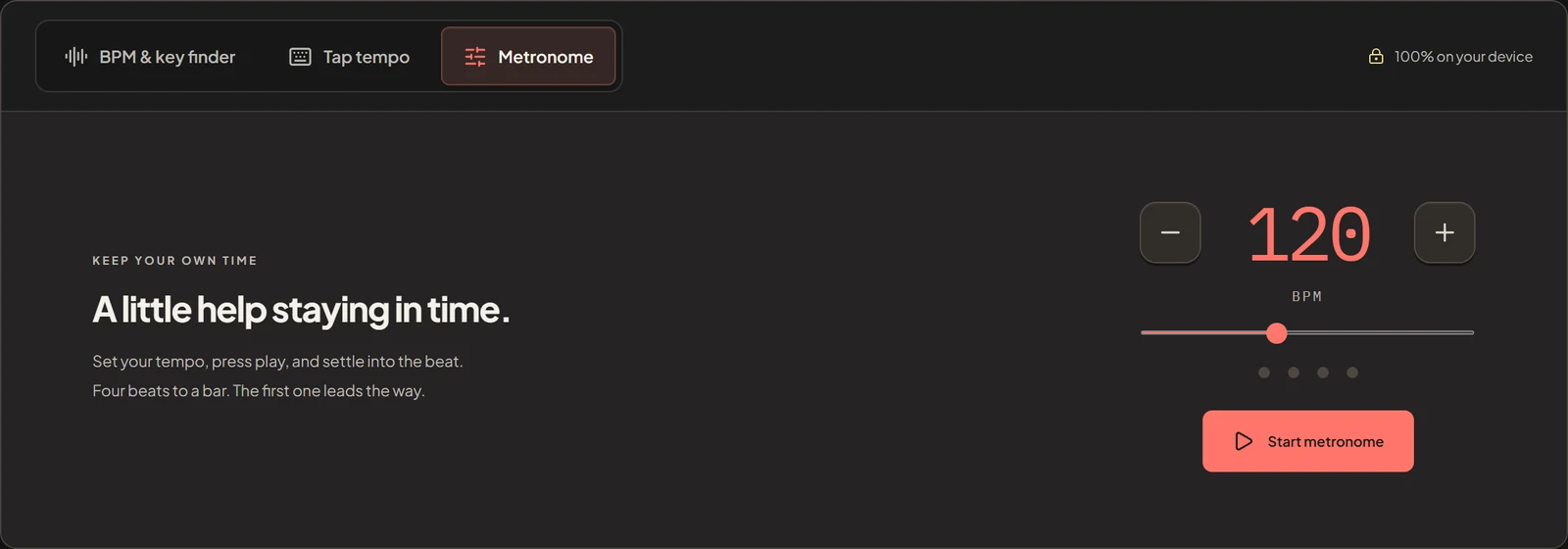
- Set one task. Aim to place one sound on each beat. Leave fills and extra notes out of the first pass.
- Keep counting through the bar line. After 4, return to 1 without inserting an extra pause.
- Listen to the relationship. Notice whether your clap lands before, with or after the click. Do not speed up the whole exercise to recover from one late note.
- Repeat a short passage. If a particular movement causes a stumble, stop after the pass and practice that movement at an easier pace.
Musical U’s lesson recommends slow counting and isolating difficult passages.[3] Staying accurate for a short, simple phrase is a more useful first check than reaching a faster setting while losing the count.
Exercise 2: count the spaces between the beats
Keep the metronome at the same BPM and say “1 and 2 and 3 and 4 and.” The numbers remain on the clicks; “and” falls halfway between them. This subdivision provides a place for the offbeat without changing the beat’s speed.[3]
The quarter-note interval is 500 ms. The even eighth-note interval is 250 ms. Adding an offbeat between clicks doubles the number of events you perform; it does not double the underlying tempo.
First say all eight syllables while clapping only the numbers. Then clap the “ands” while continuing to say the numbers. If the offbeats slide closer to one side, return to the full spoken count. You can use the BPM-to-ms calculator to check the straight note lengths for a different practice tempo.
This exercise uses even subdivisions. It is not a rule that every groove must be played straight: swing and other deliberate placements need their own listening reference. Make the goal explicit before deciding that a note is early or late.
Exercise 3: hear fewer clicks while keeping the same pulse
Once the basic pattern is stable, make the external reference less frequent. Yamaha describes moving from four clicks per 4/4 bar to two, then to a single downbeat.[2] The important part is that your intended quarter-note pulse continues at the original rate.
For a 120 BPM quarter-note exercise, a click rate of 60 per minute can represent beats 1 and 3. Count “1–2–3–4” at the original pace: click on 1, count 2 between clicks, click on 3, count 4 between clicks. Do not slow your playing to 60 BPM just because the click rate is now 60.
| Reference | Clicks per minute | Your quarter-note pulse |
|---|---|---|
| Every beat | 120 | 120 BPM |
| Beats 1 and 3 | 60 | 120 BPM |
| One click per four-beat bar | 30 | 120 BPM |
The homepage metronome supports 40–240 BPM and four beats per accent cycle. If you set it to 60, its accent cycle follows four clicks, not your four quarter-note counts. Treat all clicks alike for this exercise, or use the dedicated “Clicks on 1 and 3” recording below, whose accents follow the intended bars. One-click-per-bar at 30 is outside the homepage control’s range; use a suitable external metronome or a programmed click track for that variation.
Exercise 4: keep time through a silent bar
A missing click tests whether you can continue the pulse without following each sound. Yamaha’s lesson suggests programmed loops with silent bars.[2] The track below follows an eight-bar pattern: bars 1–2 are audible, bar 3 is silent and bar 4 brings the click back; bars 5–8 repeat that schedule.
The click returns at 6 and 14 seconds, on the next bar’s beat 1. Keep your clapping or simple phrase going across the gap; do not restart the beat when you hear the return.
Play a simple pattern continuously through the silent bars. When the click returns, notice where your next beat lands. If you have moved ahead or behind, finish the pass, then try an easier version. The aim is to observe what your count does during the gap, rather than chase the returning click.
Start here: all 32 beats are audible, with a higher click on each bar’s first beat.
Download Every beat WAVKeep counting at 120 BPM. The two clicks in each bar mark beats 1 and 3, not a new slower pulse.
Download Clicks on 1 and 3 WAVKeep going at 4–6 and 12–14 seconds. Listen for the returning downbeats at 6 and 14 seconds.
Download Silent-bar practice WAVEach track lasts eight bars. Count along for the first bar, then add your playing pattern. Replay the track for another attempt.
Exercise 5: record yourself and identify what changes
Record a short passage, then listen back. Both Musical U and The Music Studio recommend recording as a way to locate unstable sections.[3][4] For the first check, let the click be audible in the same recording as your claps or instrument. You can then compare the two sounds without trying to align separate players afterward.
Listen to the opening, the difficult movement and the return after a gap. Label the symptom before changing the exercise:
| What you hear | What to check | Next attempt |
|---|---|---|
| Increasingly ahead of the click | Rushing through the phrase | Simplify the part; keep the spoken count even |
| Increasingly behind the click | Dragging or a difficult movement | Isolate the movement at a manageable pace |
| One wrong entry, then a stable gap | Starting position rather than ongoing pace | Practice the count-in and entry |
| Uneven notes between stable clicks | Subdivision placement | Return to “1 and 2 and” |
| A consistent delay only in monitored audio | Playback or monitoring latency | Check the recording setup before judging performance |
Use a recorder or DAW you already know. A fixed recording offset and accumulated musical drift are different problems. If you use separate devices or Bluetooth monitoring, do not assume every audible delay is a playing mistake.
Keep one short example to compare with a later attempt. Judge progress on the same task at the same tempo. Deliberate expressive timing in an actual performance is a different goal from this straight, click-aligned drill.
A short routine you can repeat
Try this ten-minute routine. Spend longer on a simpler exercise if the next one breaks down.
| Time | Task | Check before moving on |
|---|---|---|
| 2 minutes | Count, clap and play one easy note | Keep the bar line moving |
| 2 minutes | Straight eighth-note subdivisions | Place the offbeats evenly |
| 2 minutes | Clicks on 1 and 3 | Retain the original quarter-note pulse |
| 2 minutes | One silent bar | Notice the return without chasing it |
| 2 minutes | Record and review one pass | Identify one change for tomorrow |
Take the skill back to a real phrase once the drill is comfortable. If your task is aligning two recorded tracks, use the DJ beatmatching guide: its rate and nudge controls solve a different problem. To check the pulse of a song before practicing, try Tap Tempo or analyze your file in the homepage workspace.
Questions about improving musical timing
Should I always practice at a slow tempo?
Choose a speed at which you can perform the specific task consistently. Slow practice helps isolate a difficult pattern; sparse-click work is a separate challenge. Change one variable at a time instead of making every exercise slower or faster by default.
Does reducing the metronome BPM mean I should play slower?
Not in the sparse-click exercise. A 60-click-per-minute reference can represent beats 1 and 3 while your quarter-note pulse stays at 120 BPM. Establish the counting relationship before starting.
How do I know whether I am rushing or dragging?
Listen to a recording containing both your playing and the click. A gap that grows ahead suggests rushing; a gap that grows behind suggests dragging. Check the recording setup if the delay is fixed rather than growing.
Sources
- Ableton Learning Music — Beat and tempoThe distinction between a repeating pulse, a drum pattern and tempo measured in BPM.
- Yamaha / Dr. Dave Gerhart — 4 Essential Metronome Exercises to Improve Your TimingPracticing with fewer clicks, changing the pulse placement and leaving bars of space in a programmed accompaniment.
- Musical U / Madars Biss — How to Improve Your Rhythm and TimingCounting slowly, subdividing the beat and recording a performance to review difficult passages.
- The Music Studio — 5 Tips to Develop Your Musical TimingUsing an initial recording to identify changes in pace and combining listening with simple physical beat keeping.