To find a song’s key, look for the note and chord that feel like a point of rest, then decide whether the music centers on a major or minor sound. That home note is called the tonic.[1] With an audio file, you can get an initial label from a key analyzer and check it against what you hear. The four methods below suit different starting points: a recording, an instrument, a chord chart or a score.
| Your starting point | Start here | Check the answer with |
|---|---|---|
| An audio file | Analyze the recording | A pitched passage and the tonic chord |
| Your ears and an instrument | Find the home note | Major and minor chords over the phrase |
| A chord progression | Trace the resolutions | The melody, bass and phrase endings |
| Sheet music | Read the key signature | The relative major/minor and sounding pitch |
1. Analyze the recording
A key finder is useful when you are preparing a folder of tracks or have a sample without a label. Use a recording that contains melody, bass or chords. A short unpitched drum loop gives an analyzer much less musical information.
- Choose the file. Open Song Key Finder and select your audio. The limit is 50 MB and 10 minutes per file, with up to 20 files in a batch. MP3 and WAV are useful starting formats; playback support also depends on your browser’s codec support.
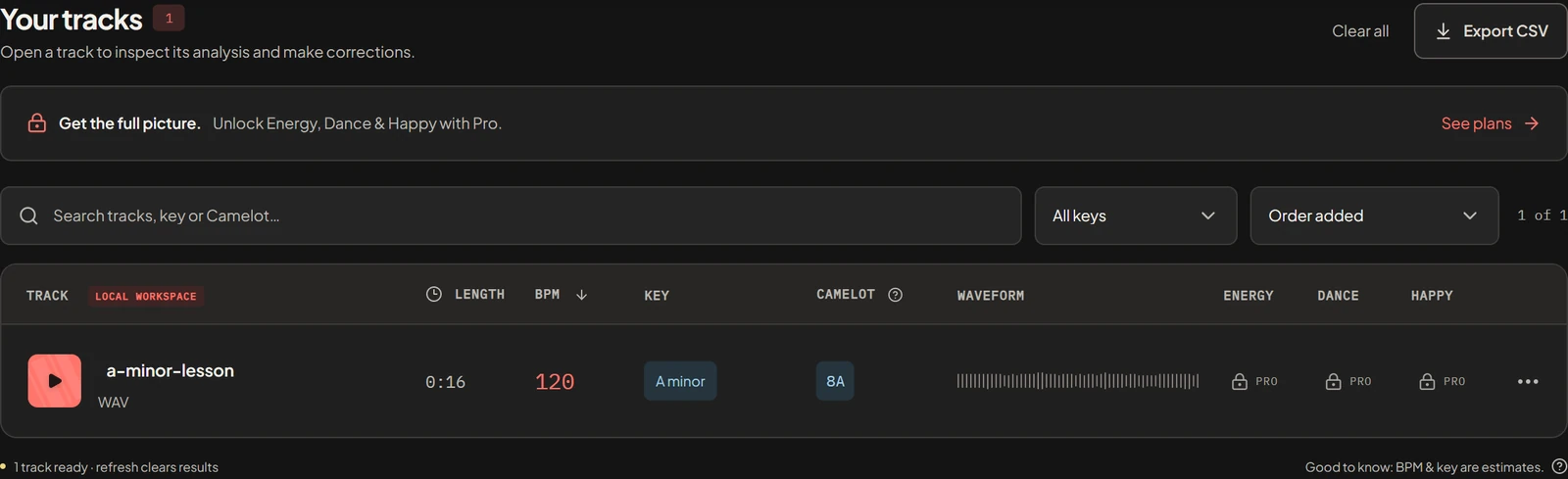
- Read the musical key first. A result such as A minor names a tonic, A, and a mode, minor. The results row shows it alongside BPM and Camelot. Wait for the file’s analysis to finish before comparing results.
- Play a clearly pitched section. Listen to the melody and bass together. If the label does not fit, open the track’s result to review or edit the key. The corresponding Camelot code updates automatically.
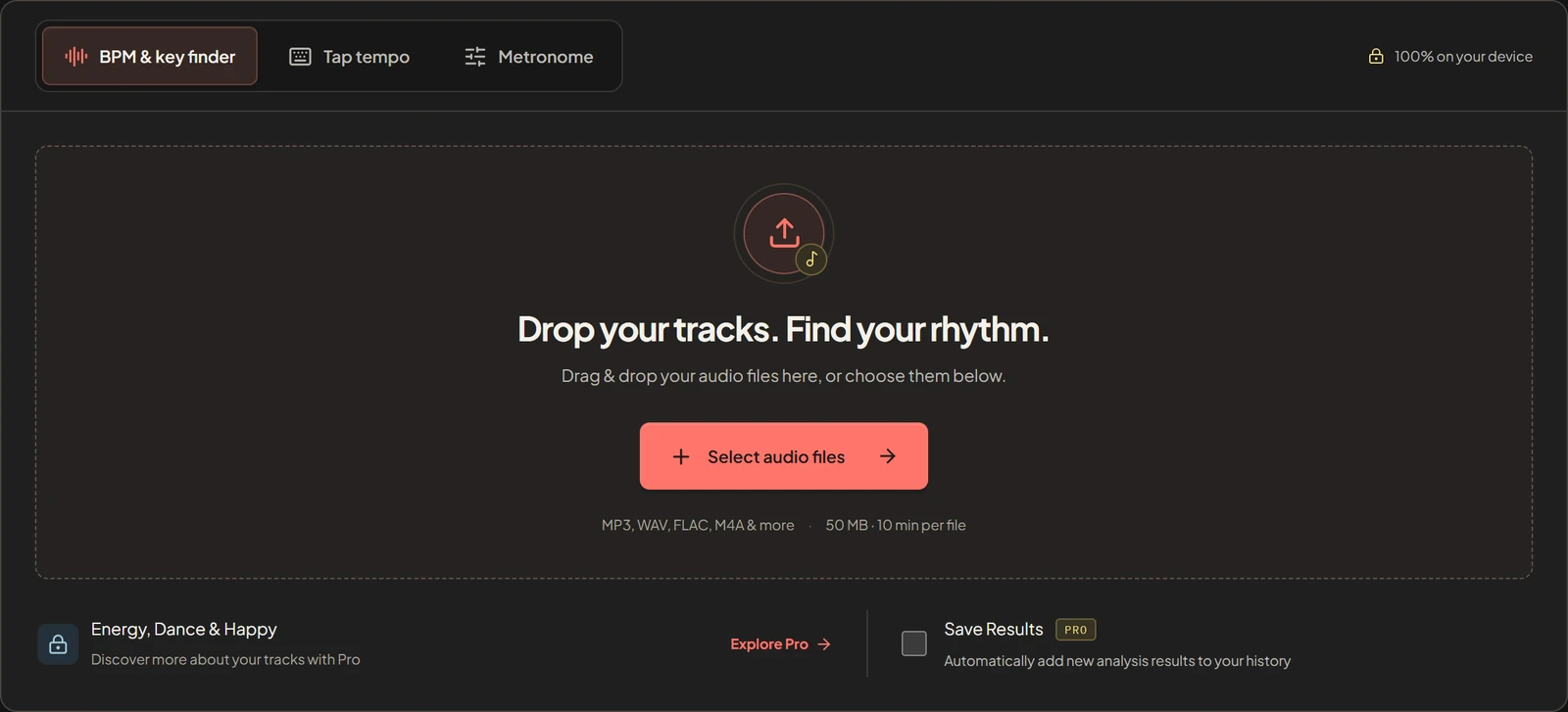
Key detection and CSV export are free. Pro adds saved results and the Energy, Dance and Happy measurements. For a recording you can download and check yourself, follow the worked example below.
2. Find the tonal home by ear
Loop a stable phrase with a clear melody and bass line. Hum a note that sounds settled when the phrase ends, then match that pitch on a piano, guitar or another tuned instrument. Try holding the note across the phrase. Does the music seem to pull back toward it?
Once you have a possible tonic, try its major and minor triads against the recording. For C, compare C–E–G with C–E♭–G. The third, E or E♭, changes the chord quality.[2] Listen for the chord that supports the phrase, rather than choosing a key only because the song sounds cheerful or sad.
These notes belong to both C major and A natural minor. A phrase that repeatedly settles on C over a C chord can suggest C major; one that settles on A over A minor can suggest A minor. The collection alone does not settle the question.[2]
C is the tonic, or home note.
A is the tonic, or home note.
The highlighted key marks a tonal center, not a different tuning. Listen to where a phrase resolves; the note collection by itself does not choose the key.
Test more than one section. An intro might avoid the tonic, a chorus might establish it more clearly, and a bridge might move elsewhere. Treat the first note, last note and lowest bass note as clues to test against the rest of the phrase.
3. Check a chord progression
If you already know the chords, compare their notes and look for recurring points of resolution. Start with the chords that feel stable at the ends of phrases. A sequence containing C, F and G is consistent with C major, particularly when G resolves to C. It is still worth checking the melody and where the progression actually comes to rest.
Am – Dm – E – Am
The first progression illustrates a return to C major. The second illustrates a return to A minor. Its E major chord contains G♯, a raised seventh relative to A natural minor; minor-key music does not have to stay within the natural-minor note collection.[4]
Avoid counting chord names as a vote. A borrowed chord, secondary dominant or pedal note can sit outside the simplest scale pattern. If you only have a two-chord loop or power chords without thirds, the major/minor choice may remain open. This site’s tool accepts audio, not typed chord lists; use this method as a separate musical check.
4. Use a score and key signature
With sheet music, begin with the key signature at the start of the staff. It narrows down the likely major key and its relative minor.[3][4] Then look at the melody, bass and phrase endings to decide which center the passage supports.
| Key signature | Major | Relative minor |
|---|---|---|
| No sharps or flats | C major | A minor |
| One sharp: F♯ | G major | E minor |
| One flat: B♭ | F major | D minor |
A key signature alone does not choose between its relative major and minor. Check that the score matches the recording’s arrangement and pitch. A live version may be transposed. If a part is written for a transposing instrument, account for its sounding pitch before comparing it with the audio.
Try it: an A minor recording you can check
Each recording is 16 seconds long: one chord per two-second bar, with the four-bar phrase played twice. Listen first, then download the same WAV and upload it to the analyzer. The A minor recording uses E major, including G♯, to lead back to Am.
Listen to G resolve to C at 6 and 14 seconds.
Download C major WAV 16 sec · 689 KBListen to E resolve to Am at 6 and 14 seconds.
Download A minor WAV 16 sec · 689 KBFollow the harmony before reading the label
In the A minor example, each pass follows this sequence. The second pass starts at 8 seconds. Try humming A over the final Am chord, or play A–C–E on an instrument.
| Time in the first pass | Chord and notes | What to check |
|---|---|---|
| 0–2 sec | Am: A–C–E | The opening tonic candidate |
| 2–4 sec | Dm: D–F–A | A move away from the tonic |
| 4–6 sec | E: E–G♯–B | The raised G♯ leads toward A |
| 6–8 sec | Am: A–C–E | The return to the home chord |
Compare with the analyzer result
- Download the A minor WAV above.
- Upload it to BPM Finder. Wait for the row to finish. In our check on October 31, 2026, the result was A minor, 8A, 120 BPM and 0:16.
- Check the answer against the sound. The Am home chord and E–Am return support the label. Repeat with the C major file: our check returned C major, 8B and 120 BPM.
- Use Camelot after checking the musical key. A minor maps to 8A and C major to 8B on the reference wheel.[5] You can then compare them in the Camelot key chart.
When two key finders disagree
First compare the actual key names. F♯ major and G♭ major are enharmonic names for the same sounding pitches in equal temperament. C major and A minor share a diatonic note collection but have different tonal centers. A disagreement between those two labels calls for listening to the harmony, rather than simply renaming the notes.
Next, compare the section and file version being analyzed. A whole-song label compresses a recording into one answer. Key changes, long percussion passages and ambiguous loops can lead to different estimates. For a mix, pay particular attention to the section where the tracks will overlap.
Camelot is a conversion from musical key, not another audio measurement. A minor converts to 8A; C major converts to 8B. Use the interactive Camelot wheel and key chart once you have a key you are comfortable using. If you manually edit a result, you are changing the label, not transposing the audio.
Questions about finding a key
Can a song have more than one key?
Yes. A recording can modulate between sections, or contain passages that do not strongly establish one tonic. A single automatic label summarizes the audio; it does not map every key change.
Does BPM tell me the key?
No. BPM measures the pace of the beat. A song at 120 BPM could be in any key. Tapping or counting beats cannot identify its tonic or major/minor mode.
Why does a drum loop get a key label?
Pitched drum resonances can favor a key profile even when the loop has no melody or harmonic progression. A returned label alone does not prove that a percussion recording has a composed musical key.
Can I find the key without knowing music theory?
Start with the audio tool, then compare the result with a few notes or chords on an instrument. You can learn the difference between a tonic, a key name and a Camelot code without transcribing the whole song.
Sources
- Ableton Learning Music — Keys and scalesThe tonic as a musical center; keys and major-scale patterns.
- Ableton Learning Music — Minor scalesThe minor-scale pattern, relative major/minor and the change from a major to a minor third.
- Music Theory for the 21st-Century Classroom — Major Key SignaturesMajor keys, sharp/flat order and reading key signatures.
- Music Theory for the 21st-Century Classroom — Minor Key SignaturesRelative minor, the raised seventh and dominant-to-tonic resolution in minor.
- Mixed In Key — Camelot WheelThe reference wheel for musical-key-to-Camelot notation.